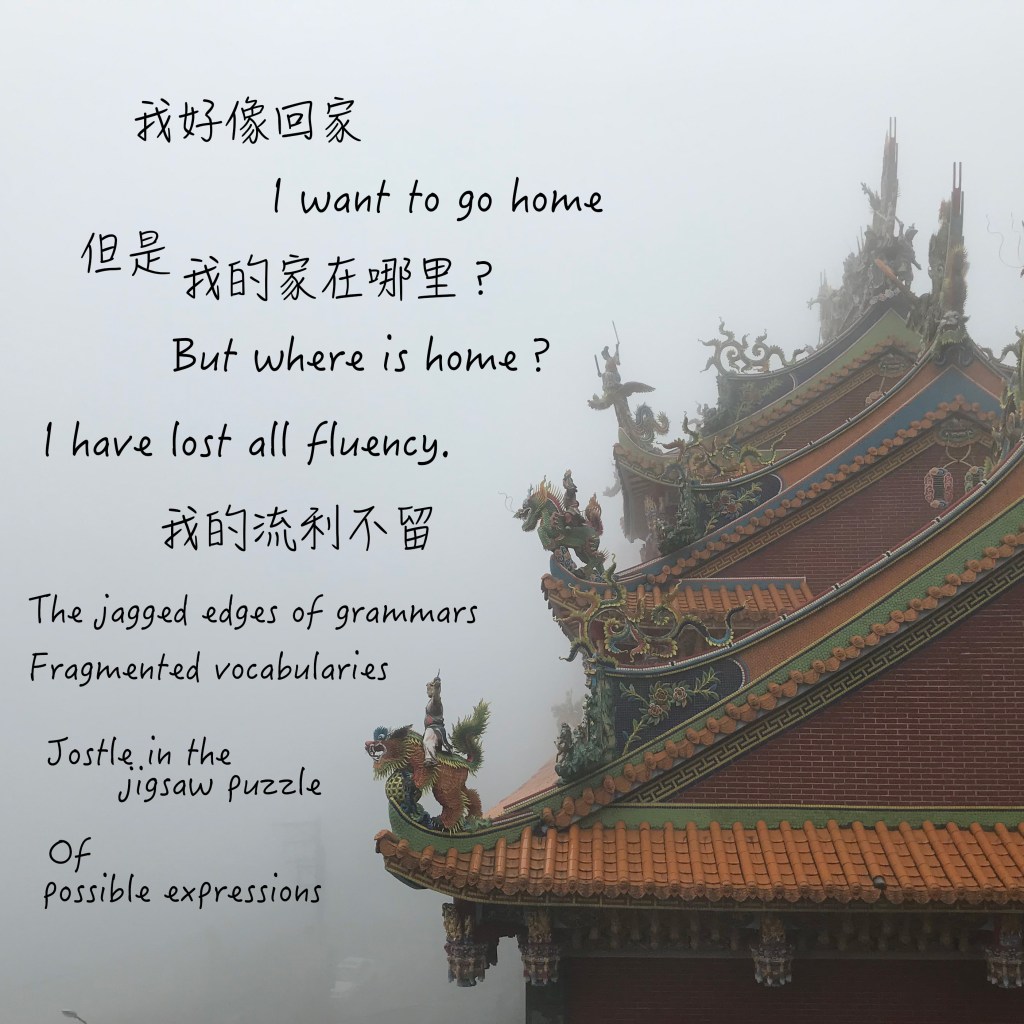
I. 我好想回家, I want to go home, 但是… 我的家在哪裡? But where is home?
I have lost all fluency. 我的流利不留. The jagged edges of grammars, fragmented vocabularies, Jostle in the jigsaw puzzle Of possible expressions.
Mouth sounds grappling to describe The perfect fractal immensity, These jumbled, bubbling impressions, boiling up From the cauldron, Life.
I may have grown here, but I am always non-native now. 我從不本地人. (Yes, I know I didn’t say exactly what I seem to have said that I said. It’s what I meant.)
To call us “Third Culture” Implies a physical space In which the venn diagram of they and they Overlap and we Snuggle cozy and warm There in between.
I have not encountered that space, If it exists. All is familiar. All is 意外,精彩, defamiliarized.
II. Can I sink into the soil somewhere? 土地公公’s realm, Jorð’s body beneath us, Sand, sea, mycelial mat.
Not yet Do I deliver this treasure hoard to Hel.
In the meantime I have questions:
Have you ever seen the snow Sliding sideways over the frozen rice paddies Carved between Korea’s mountains? Do you know the blue-tile temples, the gray tunics, cloth sandals?
The pears of 평택?
Can you smell the tan dirt trails that wind through the paddies? Taste the flat, dry persimmons and fat, autumn grapes?
Lychee in a 北京 June?
Can you feel the September evening Rolling down your skin across the yellow fields South of Київ, north of Одеса?
Do you know the old Soviet bakery perched at the cusp of the Black Sea? They used to sell cheese.
Hungarian trains bearing black-haired women wrapped up in color to the border Romanian horse carts, The discarded children of Bucureşti, Ceaușescu’s hubris.
By all of this I mean to ask, Do you know me?
For the verb, I, is all this – and so much more. Fitting together, awkward and dense as the 10,000 Daily denizens of Hong Kong’s Chungking “Mansions.”
III. So home must be like Whitman’s I Space for multitudes.
我好想回家 哪家大夠嗎 What home could accommodate me now? I am large as Hyrrokkin And teeming with the maggots of my memories.
Only I. Only whole.
This poem and many more are in the collection Ten Thousand Yous, available on Lulu.com and nowhere else, because, ya know, capitalism.
Transcript: Welcome to Ducks of the World Tree, the podcast that waddles across the manicured lawns of suburbia like an overfed pet peking, flaps wildly in front of a speeding Tesla, and then dives deep into the cool waters of – well, hopefully a pond, but probably some kind of pompous drainage ditch masquerading as a natural water feature. Anyway – come with me for the next few minutes. This one’s short. I promise.
I had grand plans for something organized and focused. And then I realized… who am I kidding? I’ve never pulled off anything resembling organized or focused in my entire life. My disaster-ass self is smeared across like 16 countries, 20 jobs, and three or four languages.
But I do have some things to say.
In this podcast, I’ll be documenting my artistic, autistic, radically animistic, ADHD journey as I stumble through life in end stage capitalism, in the endgame of ecological disaster, with a poet’s heart, a dirt-worshiping heathen’s souls… and a glimmer of hope that we can somehow reawaken something wild and authentic and rebellious and beautiful in us – in time to watch the sun set on the catastrophe of industrial civilization – together.
Before we set off on this strange and rambling journey, I want to lay out a few premises:
The first is that there are no individuals – not the way conventional western thought conceives of them. We are communities.
I am a community. All of us are communities. We’re communities of multiple fractious spirits in bodies that are communities made of animal DNA that creates a symbiotic planet for uncountable bacteria and fungi. We’re embedded in entangled communities of plants and animals who have their own soul communities and wills and desires. And we all move in a greater web of spirit communities in a kind of endless fractal magic mushroom trip vision – and all of our edges – I mean ALL of them – are kinda arbitrary.
If you’re familiar with the science behind mitochondria and chloroplasts’ independent evolution, you know that all plant and animal life on Earth is literally a community. There are no plant or animal individuals. And we’re only alive at all because photosynthetic bacteria decided to join forces with another species about 900 million years ago. Forests stand because of the communion of mycorrhizal fungi and plant roots within the soil. Human beings are band animals, in the same way that dogs are pack animals or ants are hive animals. There is no place where we can draw real, hard lines between self and other that don’t involve caveats and approximations and oversimplifications.
The second premise is that nature is alive, conscious, animate, intelligent, and willful. Trees have desires. Mycorrhizal fungi have wills. Viruses and horses and dogs and bean plants and soil all have spirit and intelligence, each in their own way. And if we utilize the time-honored techniques that traditional cultures around the world have used to open our consciousness, we will know this for ourselves. It is possible to directly experience the animacy of the world. And we should do this. We must. Because reconnecting with the huge and beautiful and consuming, spiritually alive reality behind nature is the only thing that can save us as an animal species on this planet.
The third premise is that disconnection is death. When human beings began to turn toward an increasingly mechanistic worldview, when we began to sever our understanding that we are as embedded in the world as the cells of our hand or our heart are embedded in our bodies – that is when we began to wither. We, human beings, are, in fact, threads in a great tapestry. When we remove ourselves, the tapestry begins to fall apart. We are meant to be communities held in the constant embrace of a thousand-thousand other communities. We are never alone, and yet, the specter that haunts modernity is loneliness. The feeling of disconnection, of isolation, of feeling completely adrift is the absolute hallmark of contemporary life. And it will lead to ecological collapse, as we seek to soothe our abject despair with more plastic crap we bought off another plastic website.
The fourth premise is that we can heal ourselves if we can reconnect – to the enmeshed communities of our souls, other people, the spirits of nature, the bigger spirits we might call gods, to ancestors, to the directly observable animist truth of our physical reality.And a corollary: it is difficult, if not impossible, to do any good in this world if the wound of disconnection is not repaired. Basically, hurt people hurt people. No matter what their intentions are. If someone’s ego is all big and swollen and their heart feels all dark and icky, they’re going to leak that ick. They can’t help it. And that’s why most organizations that try to do good wind up eating themselves. Everyone is still fundamentally disconnected and thinking of themselves as individuals in a hierarchy. It’s all bullshit. I pinky swear.
A fifth premise that tags along with all this talk of healing: No one can sell you the medicine. There are no saviors out there. You have to learn to breathe. You have to face the chasm in your chest and the maggots in your belly. There’s nothing to buy. There are no courses, no books, no lecture series, no $500 drum circle that will save you. Go out in the woods. Breathe. Beat a stick against the dirt. Maybe find a mushroom on a cow pattie. Make friends with people you can touch and smell. Only you can save you. Anyone trying to sell you a cure is a faker and a cheat.
With those premises out of the way, let’s talk wounds, vultures, and crochet.
If a wound has been open a long time, (10,000 years?) it’s probably infected and festering, so the first step in healing is that you’ve got to get rid of that necrotic tissue. In the natural world, the organisms that eat dead and rotting things are the detritivores – vultures, maggots, earthworms, fungi – they eat death and break it down into nutrients that new life can use to build new connections. Vultures are holy. Maggots and earthworms; Holy. Fungi – probably the holiest.
In human society, artists do something very similar to these holy creatures. We take in the pain and rot that humans have created, the dead and dying social tissue that no longer serves us, we digest it, and use it to support healthy, interdependent social tissue – healthy, reconnected, vibrant, entangled communities.
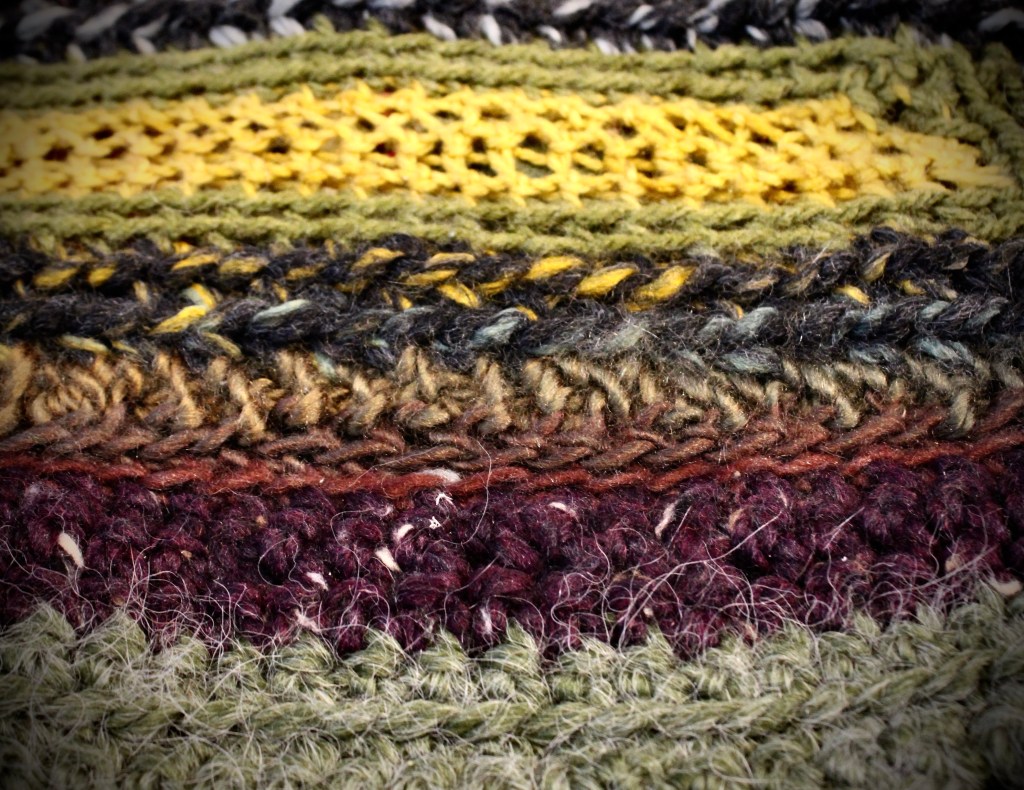
So, as an artist, I aspire to the nobility of the worm. I aspire to the vulture’s path. I serve all my communities by learning to eat… shit. And with that, spin wildly uneven yarn that we can use together to crochet new life, healthy connections, and webs of resilient communities.
And it’s no accident that I choose crochet, for my final metaphor, dear listener. Because knitting is the foundation of the entire digital age. And crochet? To this day, crochet cannot be done by a machine. It can only be done by hand. By human hands. Slowly, laboriously, with love.
And so, kind listener, I invite you to stumble along with me as I, the quintessential awkward duck, waddle along the riverbanks toward reconnection to the animate holiness of vultures and crochet.
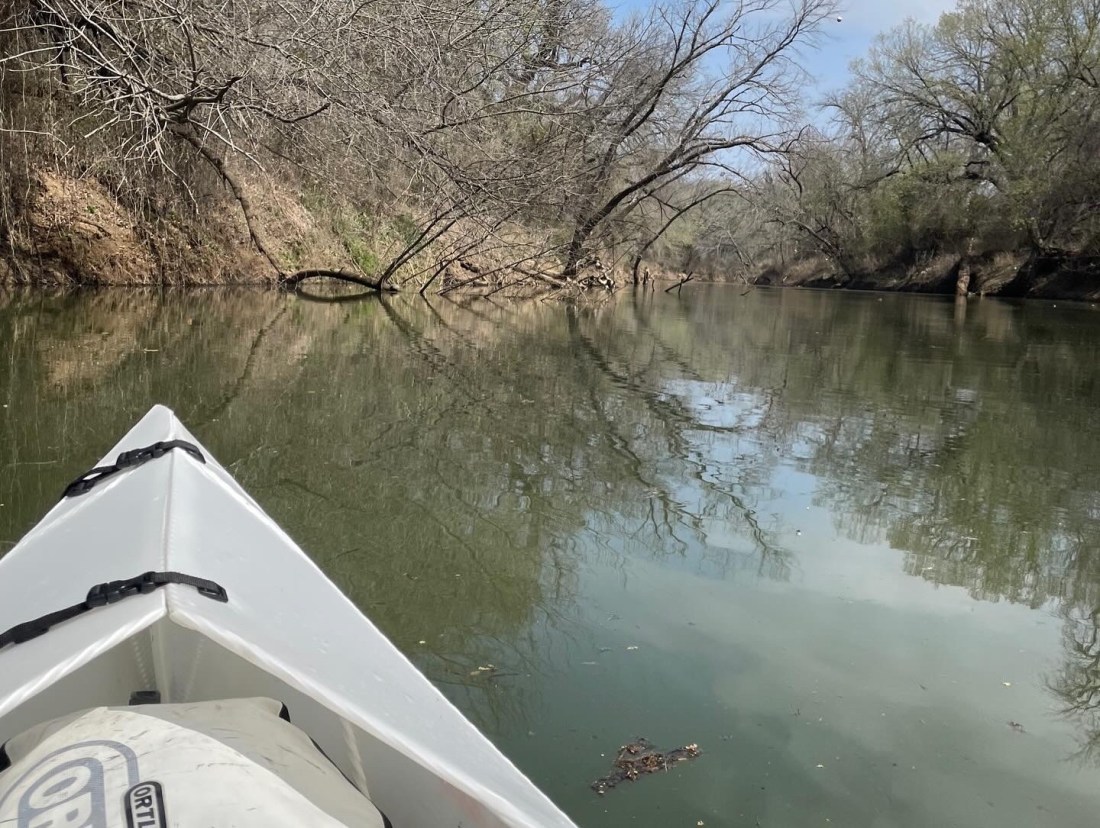
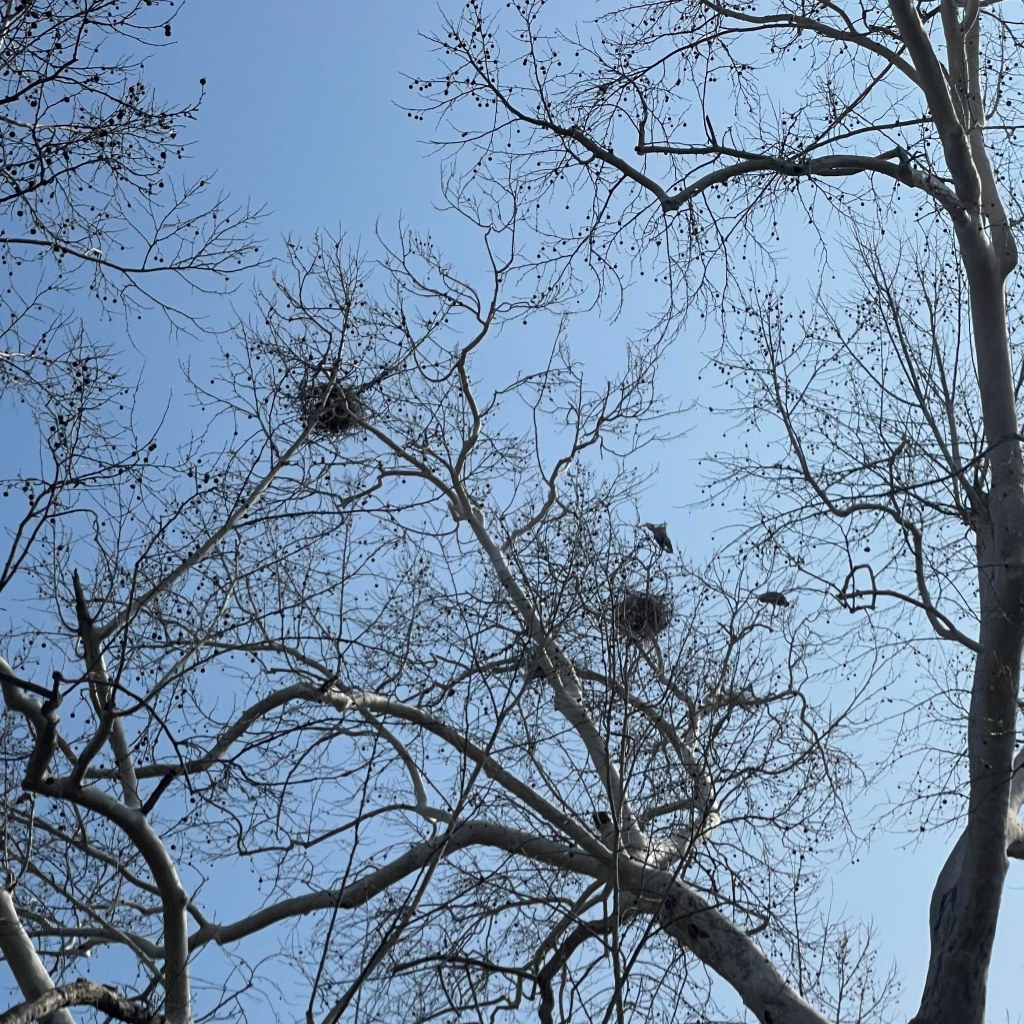
I didn’t have my good camera, so you’ll have to believe that those dark balls up in the tree are heron’s nests, not mistletoe.
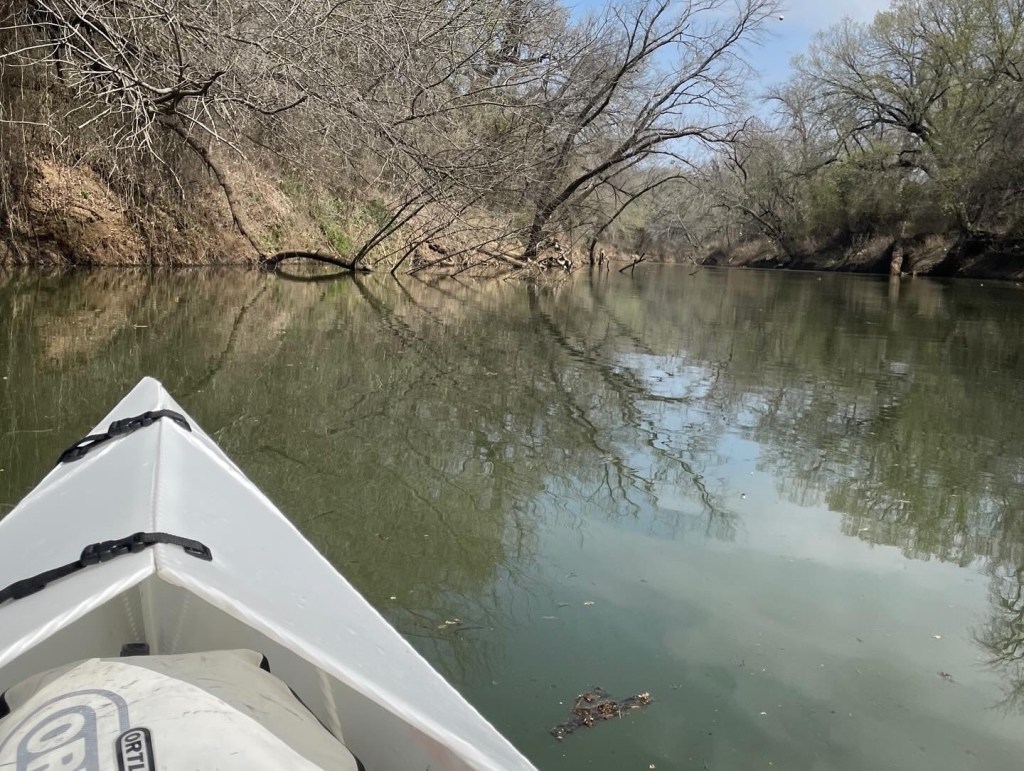
I went on a little adventure yesterday. Paddled upstream 4.64 miles in 3 hours. The current wasn’t bad in spots, but there’s a long stretch that seems unnaturally straight. It’s shallow and fast. Had to wade and drag the boat along behind. The whole business was much harder than I had anticipated (probably because I’m not very good at anticipating), but it was a wonderful experience.
The herons were not impressed.
I had paddled the kayak over to the bank to rest a moment, and two huge herons were suddenly upon me. They swooped and yelled, startling me. I hadn’t realized I was invading their nursery. When I paddled back from the bank, they retreated to their nests, watchful and irritable.
A little while later, having navigated maybe a dozen fallen trees (red-eared-slider conventions) and several areas where the limestone has eroded deeply in a long, sinuous channel, but where it is a wide, shallow shelf toward each bank, I came upon a place where erosion from a hilly area in the forest has created two little islands. As I passed the first, a raccoon (or beaver, I never really saw it) launched himself at my boat in fight-or-flight terror.
Of course, I screamed like a blonde in a slasher film.
And then I laughed and laughed and had to stop at the next little island to have lunch.
But it struck me that no matter how many plants and animals I had seen and recognized, there were countless others that had escaped my attention altogether. And I wonder about that.
Humans think we see a lot. We’re quite keen on how awesome we are. But we’re so rarely aware of what we don’t perceive. I hadn’t seen the herons, the raccoon or beaver, or several of the turtles who loudly protested my intrusion on their home. How many lives escaped the approach of my little kayak and never made a sound?
And what could I have learned from them if we could have made friends?
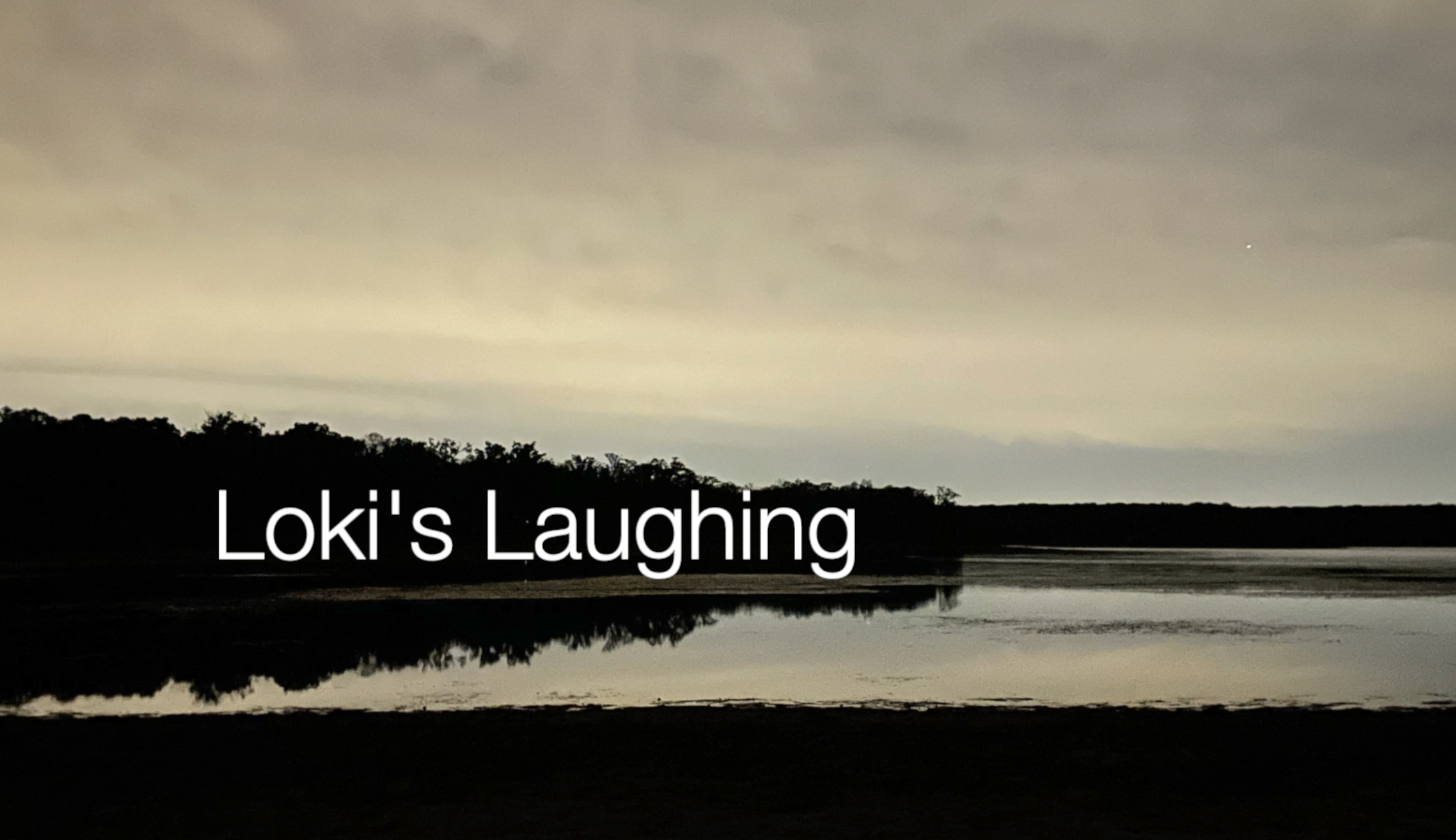
I wrote the first version of “Loki’s Laughing” during the height of COVID shutdowns. It lay there, incomplete and in rough recorded journal form (page turns and all) for three years before I pulled it out to really look at it again – which is kind of a funny story all on its own. I had been chatting with a friend about how paralyzed I felt, creatively. So paralyzed, in fact, that my song about creative paralysis was stuck in limbo. She wanted to hear it, so I uploaded it to SoundCloud for ease of sharing… and then 300-odd people wound up listening to my unfinished, unpolished journal entry within 48 hours, which was both thrilling and horrifying.
Thinking about the song again got me thinking about the feelings behind it.
From the time I was about 13 years old (when I started learning to play my dad’s old 12-string guitar) until I was 36 or so, I was an active artist. I played shows and open mics (in a few countries), I entered (and sometimes won) contests of visual art and poetry, and all my free time that wasn’t spent hiking or biking involved the creation and performance of art in some form.
But right around the time I turned 36 – so, just a little under 10 years ago from the time of this writing – I stopped creating. Altogether. I just shut down.
It was as if this horrific Paralyzing Spirit of Perfectionism took over and hollowed me out. Suddenly, after decades of creating freely, I just couldn’t. I was consumed by the fear that I would somehow create something that would trigger a cascade of online vitriol. And my fear of trolls absolutely invaded my skull. Imaginary bullies followed me into my living room. Before I even sat down with the piano or began to daydream about a story, legions of imaginary bullies were screaming at me. It was ridiculous.
What happened when I turned 36 was that I got my first smartphone.
And what had completely paralyzed me was my very first observations of the comments section on social media like YouTube and, well, the whole of Twitter.
I was tying myself in knots because I was terrified that some bored jerk on Twitter (or Tik Tok or whatever) was going to – what? Be mean to me? I spent my childhood being teased on the playground. I’ve been told I was a weirdo all my life. What’s new? What was so scary about it happening on the Internet that I was suddenly a committed devotee of rotting in unremitting, barren paralysis?
I think it’s because the Internet was suddenly in my pocket. Or bag. Or on the table next to me. I think it’s because the potential for bullying felt like it was omnipresent. Inescapable.
Social media can be a tool, if we approach it as one facet of a rich and truly multifaceted life. If the vast majority of our time is spent outdoors in the sunshine (or rain or wind or snow), or with people, plants, and animals in the actual meatspace of embodied life, if we devote ourselves to working with our hands and reading books (with pages that we can turn) and writing with a pencil and paper – if we re-inhabit our bodies – and occasionally check in on Instagram… I think, maybe, that the Internet might be a cool way to connect.
But if it takes over our skulls, if it masters us… naw. Fuck it.
Throw it away.
We can do better.
We used to share printed zines and have pirate radio shows. We used to write paper letters and meet up in libraries and coffee shops and parks. We used to ride our fucking bikes around the godsdamned neighborhood.
And ya know, that was actually pretty fucking cool.
Well anyway, here’s a video I made to go along with a song I made (with my brother). A stridently imperfect song about being creatively paralyzed and how ridiculous that really is.
Because we’re all gonna die. And the bullies are just as scared of the vast, open question that is the end of life as anyone. So fuck it. Might as well create something now.



 Ducks of the World Tree