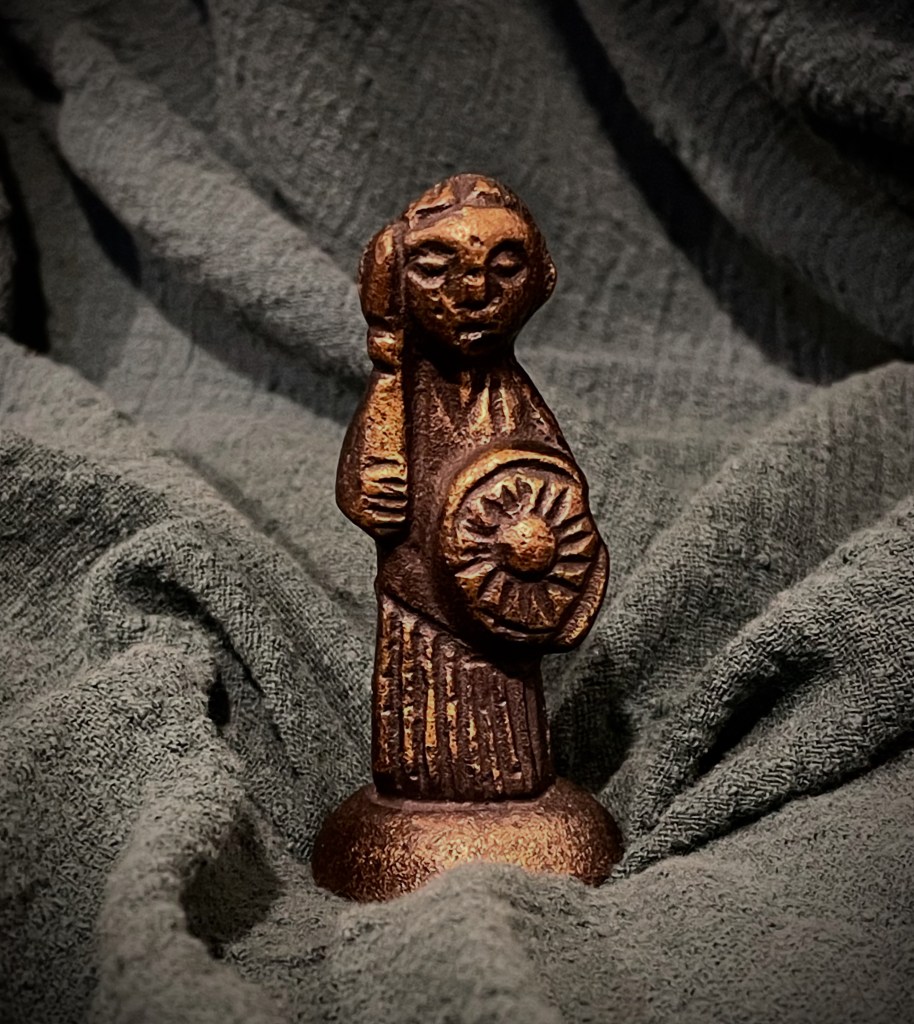
Resister: Lokasenna Reinterpreted

I marked April 18th on my calendar as Day of Resisters. 

Why this day, particularly, I have since forgotten. (I forget a lot these days. I blame it on the firehose excess of information coming in, but it may just be that sometimes I work out a problem in my mind and then once I’ve arrived at a solution, forget all the steps that got me sorted in order to save precious “disk-space” in my aging mind.)

Nonetheless, today — today I will focus on one story of resistance: Lokasenna.

In this poem, Loki has gone to a feast of the Aesir to tell them off. Having said his piece, he is pursued by the angry gods and transforms himself into a fish, but is later caught in a net of his own design. In retaliation, his sons are killed and their entrails are used to bind him in a cave. A snake which drips poison is placed above him, and his wife, Sigyn, holds a bowl over his face to shield him. When she empties the bowl, Loki’s writhing causes the Earth to shake. Basically. 

Now, I don’t think our myths ever need only one interpretation, nor do I imagine them to be literal tales of factual actions which occurred in the linear past. I think our myths are fractal metaphoric stories inspired in human poets by wise spirits, and that these stories endure because of the nearly limitless truths we can perceive in them as we turn them over, gazing into them through our own, changing, multifaceted contexts.

So, here is one interpretation of the Lokasenna.

Imagine that the gods here do not represent the good and kind and wise spirit powers. Imagine instead for a moment, that here they represent the delirious human grasping for absolute power. Capricious, ruthless, authoritarian power. Imperial, expansionist power. 

The kind of power that arbitrarily kidnaps your three children from their mother in Ironwood. 

Your children have committed no crime. Their transgressions are only supposed prophecies — unsubstantiated accusations. Potentialities. So the gods arbitrarily and capriciously toss one of your sons into the sea. They bind another son for a supposed eternity with an unbreakable bond and shove a sword in his open mouth. And they toss your daughter into the underworld — OK, she becomes goddess of said underworld, but still. Your three children have been kidnapped and renditioned to lands you cannot reach. You cannot rescue them.

Then you’re accused of orchestrating Balder’s death (only by Snorri, not by Saxo, but these rumors are clearly dangerous since no one is engaging in due process). Rather than disappearing into the humble, cowed night, you walk yourself directly into the gods’ party and you tell them off.

You use the shield of your old blood oath, your passport, to enter the space of power. You tell them off. And then, you have to flee, to hopefully fight another day, because now, Thor is after you. (Not Thor, protector of Midgard, not our friend, the god, not your longtime traveling companion, but here, a metaphoric representation of violent, irresistible, physical power.)

You slip away, but these authoritarians pursue you. You imagine all the ways they could catch you and you try to plan your various escapes, but in the end, they use your own mind — your own ideas — to snare you.

They imprison you. Tie you to a stone using the guts of your murdered child. Your partner does what she can. She tries to shield your face from the unceasing drops of venom — but sometimes she must empty the bowl.

And then, your writhing is the source of earthquakes. The injustice of your imprisonment and torture shakes the world. 

The story doesn’t end there; authoritarians always sow the seeds of their own destruction. In torturing you and your family, they’ve created the enemies they sought to defeat. And you don’t survive, but you do end their rule.

I think this is one interpretation. I couldn’t really have seen it before now. But today, it feels like the most important interpretation. 

Today, it feels like prophecy.
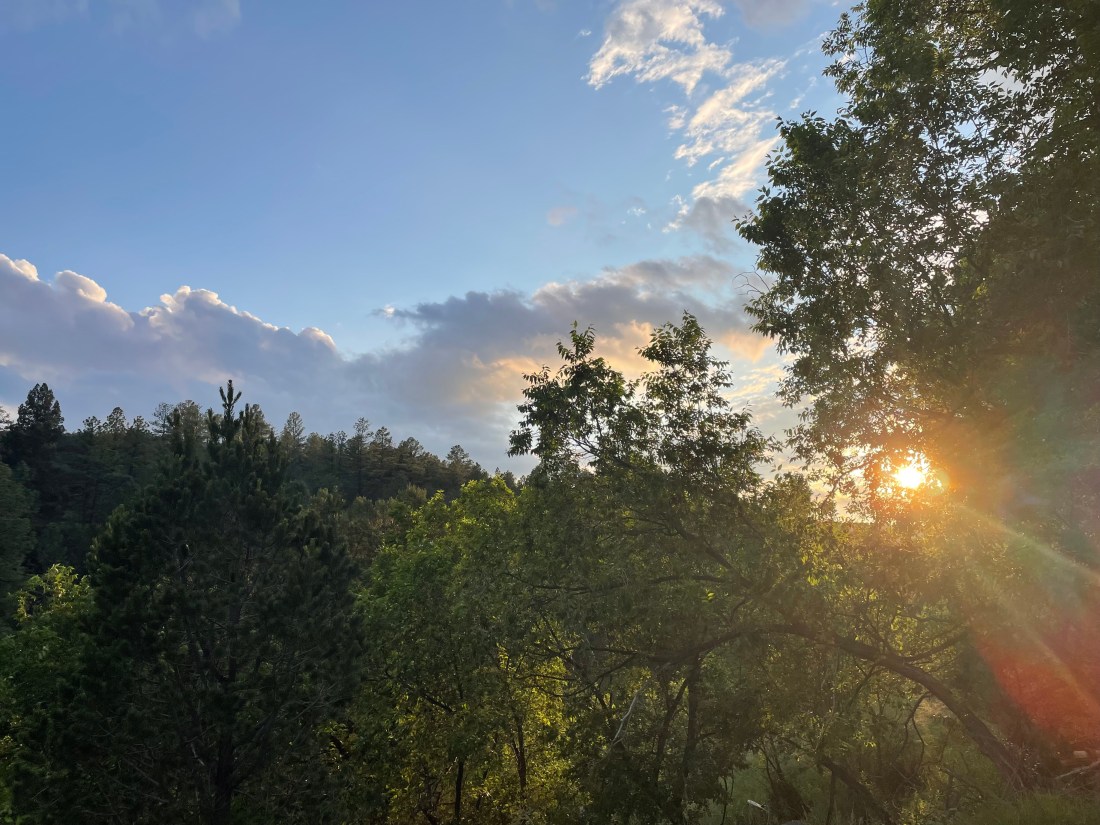
The Seed, Ingvi

Once upon a time, as all good stories begin…

Long, long ago, longer than the memories of stones, somewhere in the primordial star-dust soup of the primitive Earth, five elements – carbon, hydrogen, oxygen, nitrogen, and phosphorus –  were electrified.

We do not know how or why the ancient lightning came, but we know it did. Because it left a very curious mark in the wordless record of Earth: Life.

Elements joined hands, formed chains of molecules, and these molecules, agitated by the storm-charge of the young atmosphere, began to replicate themselves in an insensate urge. Copy, copy, copy. Over vast eons, these self-replicating molecules became the instruction manual for new alliances. A phospho-lipid bi-layer. A cell wall. Semi-permeable membranes. 

Cells.

These cells began to eat. To consume one another in order to assimilate the chemical and photic energy of the young cosmos. 

Over even longer stretches of time, one visionary cell, rather than eating another and digesting it, entered into symbiosis with it. Together they were stronger, more energetic. Possibilities opened. And the mitochondria was born. The mitochondria that produces the chemical energy for you to walk in this forest today, those very mitochondria are the descendent copies of some of the earliest, free-living bacteria which joined the primitive eukaryotic cells. 

You are not yourself. Even in your cells. You are defined by community, even at the smallest division of your body. 

Separated by millenia, it happened again. A different rebel cell joined forces with a little, green, free-living mote. And the chlorophyll was born. All plants on Earth descend from this one, revolutionary ancestor. These trees all around you, they are their children. They, too are in-divisible, cannot be individuals, for if you cut the photosynthetic chlorophyll away, you have a dead plant cell. Neither can make a tree without the other.

Once the cells understood the power they had when they chose to work together, multicellular life forms were born and proliferated across land and sea. The exquisite vascular tissue, spores and flowering plants. The smallest aquatic life and the whales with four-chambered hearts the size of a wild boar. Legs. Wings. Reptiles and birds. And later, mammals.

So much creativity. 

All unfolding from a little lightning. A few atoms joining their electron hands.

Atoms that formed in the intense heat of collapsing stars.

You know the hemoglobin in your blood is able to carry its little cargo of oxygen because of iron born in a fusion reaction at the heart of an exhausted star. Life depends on death, always. Life eats death, tears it to shreds, and re-organizes it. 

You are star-dust, self-organizing. 

Light itself is the union of wave and particle. Fast-moving light is energy, radiation, heat. And when energy slows, it cools, it transforms into matter. There are no individuals. Even light itself is in-divisible.  

All the universe’s brilliant creativity is defined by union. And you, you are the perfect expression of the universe’s creativity.

For all of time, your ancestors, long before they were human hunter-gatherers eating their way through Eden, joined electron hands and released them in the unending fractal dance that is Life. 

Look at your body. Is it made according to the instructions inscribed over four-and-a-half billion years in the language of carbon, hydrogen, oxygen, and phosphorus – which were themselves born in the death of untold-billion-year-old stars. You are already ancient. You are already reborn. There is no need to fear age and death.

The body-building code you see today was inscribed in your DNA over the 200,000 or so years that humanity wandered lightly across the land, gathering fruit here in spring, nuts there in fall. Do not despair that you find modernity stern and unyielding; you are perfectly created to be a peripatetic gardener of the savannahs. Humanity can change its environment, but we cannot change ourselves. Despair is natural to a caged bird.

Still, sing.

This time is but a blip in the cosmic order. It will pass. But the self-replicating light that forms you now, it cannot die. Because energy can be neither created nor destroyed in the universe. It can only change form.

And it must change form, always. Constantly, it flows. Energy that does not flow… becomes infinitely dense. Infinitely cold. 

So dance. Dance now. The divine light is your divine structure. It is perfect. 

As are you.

The Herons Were Annoyed

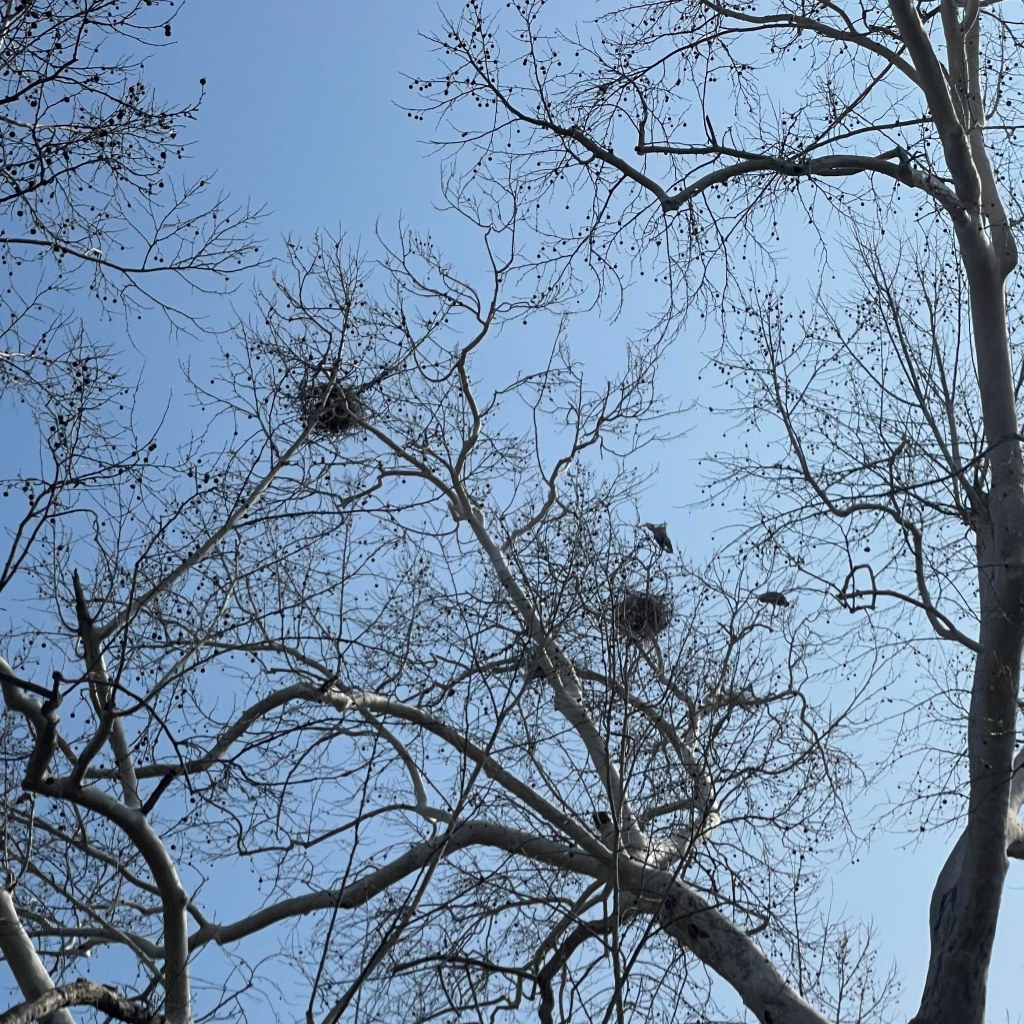
I didn’t have my good camera, so you’ll have to believe that those dark balls up in the tree are heron’s nests, not mistletoe.

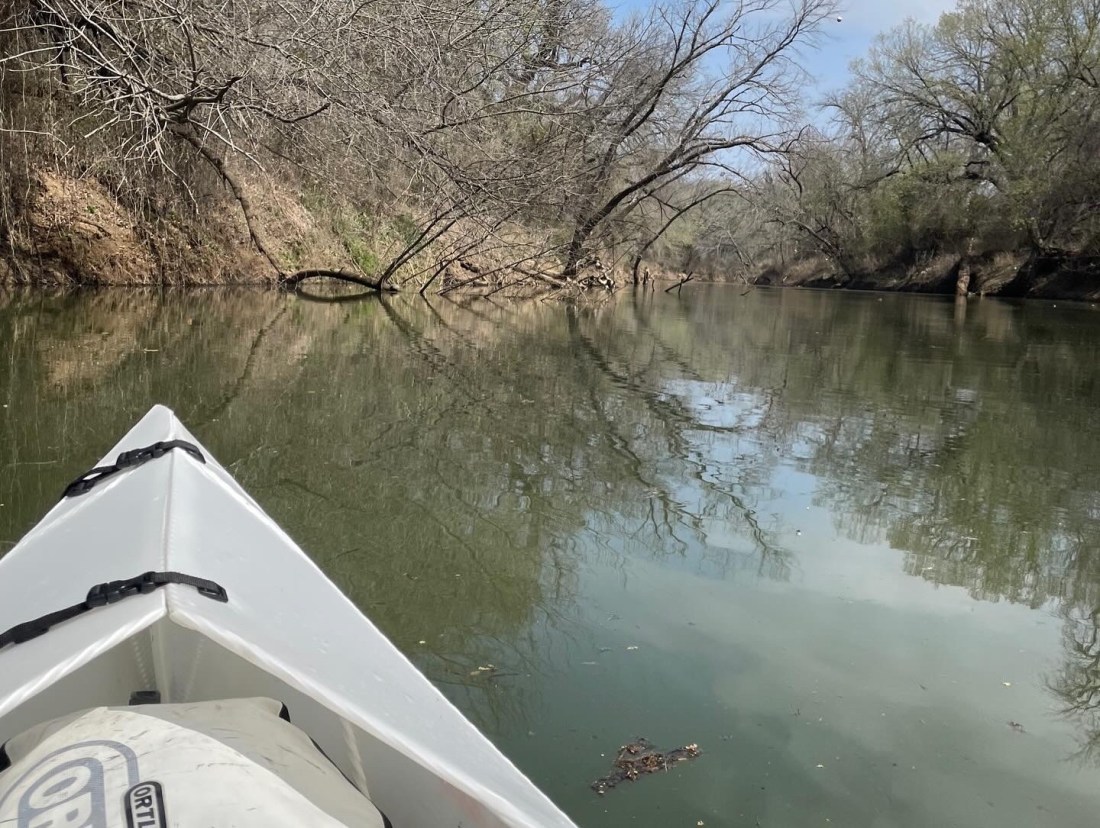
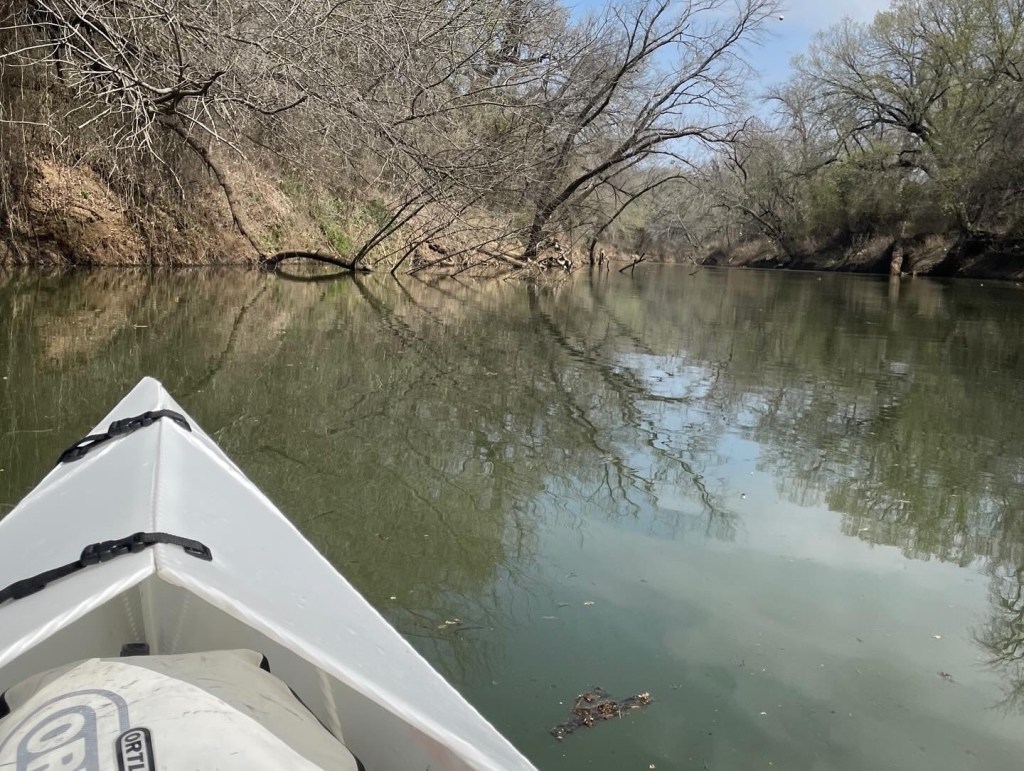
I went on a little adventure yesterday. Paddled upstream 4.64 miles in 3 hours. The current wasn’t bad in spots, but there’s a long stretch that seems unnaturally straight. It’s shallow and fast. Had to wade and drag the boat along behind. The whole business was much harder than I had anticipated (probably because I’m not very good at anticipating), but it was a wonderful experience.

The herons were not impressed.

I had paddled the kayak over to the bank to rest a moment, and two huge herons were suddenly upon me. They swooped and yelled, startling me. I hadn’t realized I was invading their nursery. When I paddled back from the bank, they retreated to their nests, watchful and irritable.

A little while later, having navigated maybe a dozen fallen trees (red-eared-slider conventions) and several areas where the limestone has eroded deeply in a long, sinuous channel, but where it is a wide, shallow shelf toward each bank, I came upon a place where erosion from a hilly area in the forest has created two little islands. As I passed the first, a raccoon (or beaver, I never really saw it) launched himself at my boat in fight-or-flight terror.

Of course, I screamed like a blonde in a slasher film.

And then I laughed and laughed and had to stop at the next little island to have lunch.

But it struck me that no matter how many plants and animals I had seen and recognized, there were countless others that had escaped my attention altogether. And I wonder about that.

Humans think we see a lot. We’re quite keen on how awesome we are. But we’re so rarely aware of what we don’t perceive. I hadn’t seen the herons, the raccoon or beaver, or several of the turtles who loudly protested my intrusion on their home. How many lives escaped the approach of my little kayak and never made a sound?

And what could I have learned from them if we could have made friends?