I recently recorded a podcast episode with a friend (details forthcoming) with the title “Everything is Made of God.”
The premise that we were working with is that if we approach the entire world as if it really were a part of God — a part of the original One Great Being — we are more likely to make choices about how we alter our environment that are less destructive. My argument is essentially this: if the narrative that we’ve grown up with is that Ymir’s hair (stick with me for a second if you’re unfamiliar with Norse creation myths) really became the trees of the Earth, and that the gods Odin, Hoenir, and Lodurr, (or Odin, Villi, and Ve) shaped the trees into the first man and woman, then not only are the trees and forests our ancestors and worthy of veneration, all mankind is your beloved sibling — there is no room for notions of “illegal aliens” or hierarchies of skin tone if we are all descendants of Ask and Embla — and all the material world is shaped of Ymir’s divine body.
It doesn’t matter that it’s obviously scientifically silly to say that the clouds are a dead giant’s brains or the sea is Ymir’s blood. It doesn’t matter if it’s a “true” story in the sense that saying two hydrogen atoms and one oxygen atom make up a water molecule is objectively true. The Ymir myth is a narrative that, I argue, equips us with a worldview that promotes decision making that is healthier, more equitable, more likely to defuse conflict, more likely to produce systems that work for humans and other animals and plants, fungi and all the other living beings of the planet.
So, the brief story of Ymir drawn from the poetic and prose Eddas runs like this: Primordial Fire and Primordial Ice meet up in The Big Empty, and the primordial giant, Ymir, is formed. From his sweat arises more beings. Some of these, the gods, essentially hack up Ymir to make Earth — who is herself conceived of as a conscious and willful goddess, Jord. Ymir’s bones and flesh become mountains, rocks, and soil, his blood is the sea, his hair is the trees, his brains make the clouds, his skull is the vault of the sky and so on.
One of the things we had to contest with (in my conversation for this podcast) is the idea of “double vision” — or, more likely, “fractal vision.” We may see the world on a spiritual level one way, but on a scientific or political level, we may see things differently.
The crux of “double vision” runs like this: just because I recognize someone as a beloved sibling who is making terrible choices as a result of crushing anxiety doesn’t mean that I’m not going to punch that someone if they’re trying to assault or kidnap my neighbor.
Just because I recognize the underlying unity of all people, (and beasts, and trees) doesn’t mean that anyone gets a pass on starving kids (or anyone else) for political aims. Genocide is genocide.
Nazi is as Nazi does, and we do not tolerate Nazis in this house; that’s how you wind up with your tattoos as lampshades.
So, if I’m coming at the world with a very pantheistic, animistic, hippie perspective, how do I deal with the obvious presence of evil in the world?
In short, bodies get sick. That is natural. We have to deal with sickness appropriately.
Here’s how I see it: human beings are deeply anxious little animals. We’re scared that we’re not good enough. We’re scared of death. We’re scared that our friends will reject us, that we won’t find love, that our loved ones will leave. We’re anxious about winter and we’re anxious about the rain, we’re anxious that the crops won’t produce enough and we’re worried that the animals are sick or the hunting won’t go well or that the baby will die or mother will die in childbirth. All these are legitimate fears. But at core, we are tense, vulnerable little creatures with a strong — overpowering — desire to feel that we are in control.
Our bid for control can go in essentially one of two directions. We can develop distress tolerance, be OK with the fact that everything is not OK, exercise our own agency to improve relations with the other people and beings around us by improving our own mental health, or we can seek power over others. We can approach the world as though “I” were the only subject, all else is dead “objects” to be used, discarded, or dominated, and generally act like a prick, Nazi, tyrant, authoritarian rancid shoe.
We all have anxiety. We can deal with it by developing agency to manage our own minds and relationships. We can deal with it by developing power over others and generally ignoring the growing pit of sorrow in our own hearts and substituting various toxic mimics of camaraderie for real relationships.
Those are our choices. How we deal with the sickness of anxiety is ultimately a choice. How we deal with sickness in the body politic is also a choice.
So imagine for a moment. A kid who should have been diagnosed with dyslexia, or given support for a reading comprehension disability. Rather than compassion and kindness, rather than being encouraged to do all the things that kid is certainly good at, the kid is given distain and impatience. The kid internalizes all that negativity. His anxiety that he’s not good enough, that he’s worthless, that may become depression or rage. He may turn self-hatred into any number of forms of egoism; the sentiment that “I’m better than them” — whoever they are — is always insecurity masquerading as superiority.
Think about the sort of people you have seen declaring that “whites” are “the superior race.” There are often visible signs that this person is not all right. How can we help that person heal from their delusions and begin to deal with their natural anxiety in a healthier way? Can we help them heal? (Or is our only option to endure the shitstorm and start fresh in a post-apocalyptic hellscape with aggressively animistic stories that inoculate the next generation from identitarian dumbfuckery and promote relational justice with all beings?)
And sometimes people are just evil. I know from my own firsthand experience that some sociopaths are just born that way. But most of our modern brownshirt cosplaying dweebs… they’re just looking for a way to feel a little better about themselves, and the only narrative they’ve been offered is power over, better than, domination.
So, double vision:
I really fucking hate Nazis.
I also really fucking believe that all beings are descended from Ymir, and that on a spiritual, biochemical, fundamental level, we are all interdependent and inextricable.
Double vision:
I can develop compassion for the dude who joins some backward bullshit federal agency because he’s broke and has no moral compass. That doesn’t mean I’m opposed to punching Nazis where needed.
And in response to either compassion or a solid right hook they’ll probably shoot me in the face.
And then I will return to the One Great Being — or maybe I’ll haunt that murderer’s ass with such a ferocity that he wishes he could exit stage left. And maybe my haunting ass ghost will make sure that self-hating, lonely, desperate, murderous douche canoe stays alive until he is ninety-fucking-nine years old, trapped in a decrepit body, unable to think about anything other than the mediocrity of his finest hour.
You never know.
In a living world made from the body of a dead god, you just never know.
I marked April 18th on my calendar as Day of Resisters.
Why this day, particularly, I have since forgotten. (I forget a lot these days. I blame it on the firehose excess of information coming in, but it may just be that sometimes I work out a problem in my mind and then once I’ve arrived at a solution, forget all the steps that got me sorted in order to save precious “disk-space” in my aging mind.)
Nonetheless, today — today I will focus on one story of resistance: Lokasenna.
In this poem, Loki has gone to a feast of the Aesir to tell them off. Having said his piece, he is pursued by the angry gods and transforms himself into a fish, but is later caught in a net of his own design. In retaliation, his sons are killed and their entrails are used to bind him in a cave. A snake which drips poison is placed above him, and his wife, Sigyn, holds a bowl over his face to shield him. When she empties the bowl, Loki’s writhing causes the Earth to shake. Basically.
Now, I don’t think our myths ever need only one interpretation, nor do I imagine them to be literal tales of factual actions which occurred in the linear past. I think our myths are fractal metaphoric stories inspired in human poets by wise spirits, and that these stories endure because of the nearly limitless truths we can perceive in them as we turn them over, gazing into them through our own, changing, multifaceted contexts.
So, here is one interpretation of the Lokasenna.
Imagine that the gods here do not represent the good and kind and wise spirit powers. Imagine instead for a moment, that here they represent the delirious human grasping for absolute power. Capricious, ruthless, authoritarian power. Imperial, expansionist power.
The kind of power that arbitrarily kidnaps your three children from their mother in Ironwood.
Your children have committed no crime. Their transgressions are only supposed prophecies — unsubstantiated accusations. Potentialities. So the gods arbitrarily and capriciously toss one of your sons into the sea. They bind another son for a supposed eternity with an unbreakable bond and shove a sword in his open mouth. And they toss your daughter into the underworld — OK, she becomes goddess of said underworld, but still. Your three children have been kidnapped and renditioned to lands you cannot reach. You cannot rescue them.
Then you’re accused of orchestrating Balder’s death (only by Snorri, not by Saxo, but these rumors are clearly dangerous since no one is engaging in due process). Rather than disappearing into the humble, cowed night, you walk yourself directly into the gods’ party and you tell them off.
You use the shield of your old blood oath, your passport, to enter the space of power. You tell them off. And then, you have to flee, to hopefully fight another day, because now, Thor is after you. (Not Thor, protector of Midgard, not our friend, the god, not your longtime traveling companion, but here, a metaphoric representation of violent, irresistible, physical power.)
You slip away, but these authoritarians pursue you. You imagine all the ways they could catch you and you try to plan your various escapes, but in the end, they use your own mind — your own ideas — to snare you.
They imprison you. Tie you to a stone using the guts of your murdered child. Your partner does what she can. She tries to shield your face from the unceasing drops of venom — but sometimes she must empty the bowl.
And then, your writhing is the source of earthquakes. The injustice of your imprisonment and torture shakes the world.
The story doesn’t end there; authoritarians always sow the seeds of their own destruction. In torturing you and your family, they’ve created the enemies they sought to defeat. And you don’t survive, but you do end their rule.
I think this is one interpretation. I couldn’t really have seen it before now. But today, it feels like the most important interpretation.
Hello and welcome to Ducks of the World Tree, the podcast that waddles across the manicured lawns of suburbia, flaps wildly in front of a speeding Tesla, and then dives deep into the tepid waters of some kind of pompous drainage ditch masquerading as a natural water feature.
In today’s tales of neurodivergent, animist wanderings through end stage capitalism, we’re talking about ADHD, and the fracturing of the self, and desire, and we’ll prolly take at least a few dark alley sidequests.
So, I started writing this episode months ago, and a lot of shit happened.
One, because America hates actual healthcare, I couldn’t get my ADHD meds for several months. And if you’ve ever wondered what kind of effect that has on a person, well, have I got a brief but colorful narrative for you.
Basically I couldn’t sit still long enough to type much of anything, whatever I did write was jumbled and unintelligible, and the issues with task initiation and task switching that I always have, even when my meds are perfect were like… fuckin’… just no. I was totally disabled.
So cool.
Simultaneously, all the pillars of my life crumbled. Like all the things that I was doing that made me, me started to implode around me. So compounding my medical distress, I was having what amounted to an identity crisis, a lot of heartbreak, general disappointment, existential fracturing…
And because I am very much an ADHDer, I’m already really existentially fractured. I’ve lived in/worked in/traveled through/ridden my bike through/lived on an off grid farm in like 16 countries. I’ve got degrees in Latin and Ancient Greek (which I remember almost none of) and I’ve studied Old Norse, Old English, modern Korean, Chinese (both traditional and simplified character sets), Spanish, Norwegian and Swedish, modern Icelandic all to at least an A2 level, a couple into B1 and C1 territory. I’ve won contests of poetry and painting, had music gigs in a couple countries, and promptly lost interest in doing the thing at all. I’ve lost interest in more hobbies, degrees, and certifications than most people have ever even had.
Which brings me back to what I initially wanted to talk about.
Desire.
What do you want?
On the surface, that seems like a fairly straightforward question. But it isn’t.
What do you want economically for yourself? What do you want in terms of what will make you happiest? Can you draw the venn diagram of what-I-like and what-I-can-get-paid-for and get any overlap?
What do you want for the planet? For future generations? For the trees and critters of the forest and field? For the seas?
What do you want for dinner?
I think maybe I bit off a little more than I can chew.
…
I want to take a little detour now through the concept of multiple souls, because I think it’s a really useful theoretical lens through which to really interrogate desire, the self, a fractured identity and neurodivergence.
Quick background info lecture mode:
Various cultures throughout the history of the world have posited that human beings (and other beings) have multiple souls. In Chinese Daoism, you have at least the hun2 and po4 if not also several other function-specific souls. Many shamanistic cultures have a belief that a separate “free soul” or a “wander soul” is what goes off to the other world when the shaman is journeying. Indigenous groups as diverse as the Inuit and the Bakongo hold a variety of beliefs regarding multiple souls. And in pre-christian, Germanic-speaking Europe, we surmise, based on the textual evidence found in translations of the bible into Gothic and the Heliand in Old Saxon as well as other texts, that Germanic-speaking pagans also held complex beliefs about multiple souls – or at the very least, they had distinct words for different aspects of their minds, emotions, and personalities and in the context of translation, it sure looks like they’re thinking of them as separate souls.
Winifred Hodge Rose has spent something like 25 years researching Gothic, Old Norse, Saxon, Old High German, Old English… I’m forgetting some, but you get the idea… and really drawing out the idea of multiple souls, what each soul’s character might be, and so on. If this idea makes you happy and excited, and this sidebar sparks joy, search for her books.
If you’re wanting me to get on with things, just focus on this:
The Will and The Wish, the Mod and the Hugr, are two different ideas for speakers of the old Germanic languages. One soul can want one thing, and the other soul can want something totally different. Your Will, and your Wish can be pulling you in different directions.
If you take it as a metaphor, great. That works as a way of getting the inner workings of the mind out on the page so you can understand them and maybe do something about them.
But I think it works better if, for a moment, you take it literally. Because that really describes what internal conflict feels like. It feels like one of your souls, one of your selves, is determined to do one thing, another soul, another self is determined to do something else, and your meat-sack-midgard-ship of a body is going to break apart.
…
I feel like I should take another dark-alley-aside here to tell you that I often have double or triple vision with respect to these things. I can simultaneously hold a materialist, atheist perspective, an animist, multiple souls, shamanistic perspective, move back and forth between taking all this very literally and very metaphorically without any problem. That’s just who I am. I am large. I contain multitudes.
So while I think the most useful and probably the most true default framework for thinking about life on Earth should be animistic – that everything has its own mind and will, and pantheistic – that the universe is a manifestation of the divine. And I think it’s quite likely that not only do we have a spiritual reality that infuses all the meat, our multiple souls are literally separate spirit beings within us. At the same time, I’m like… anti-orthodox. Metaphor is also powerful and helpful.
…
Ok. So back to will and wish and desire.
What do you want? You probably have a lot of mutually exclusive answers to that. I know I do. The more honest I am, the more I see all these different aspects of my self that feel irreconcilable. It’s a fucking high school cafeteria inside my head and heart.
How can you share the one meat-ship that you have with all these selves? You only have this one timeline that you know about for sure. You can’t count on reincarnation or heaven. Nothing but death is like for-sure, definitely promised. So. For the time in between your mom and some maggots, what do you want?
(All praise be to Ani D for the mom and maggots line).
A lot of western, modern thinking is solipsistic – main character syndrome – you are the only subject, the only do-er, you’re the only one who matters, and you just march around doing what you want. You cut the forest down for money and don’t lose sleep because – they’re just TREES, they’re not subjects, they’re objects. They don’t have VALUE until you turn them into toilet paper, duh. YOU are the only subject, anyway, right? It’s kind of a lonely, sociopathic way of thinking.
But desire becomes complex if you are not the only subject. If you live in a world of subjects, desire becomes more of a negotiation, which I think is healthy – healthier than the typical western materialist perspective, anyway.
First, it’s like who even am I? Am I singular? Am I a community of souls or soul parts? Next, it’s like, what do I want vs. what do my friends and family want? My roommates? My romantic partners? What do they want? What does my future-self want vs. what does my now-self want? The world is filled with people who have soft bodies and delicate hearts. The way you act on your desires impacts them.
Here’s a line of thinking:
If I stay in America, my mom and dad will be happy. My friends and students and the kids I babysit will be happy. But I will be increasingly sad. Because the more time passes, the more I feel their plans and their desires have become a cage. Am I an individual? A community? Do I need to take my multiple souls to therapy? Am I a thread in a tapestry? I mean, it’s a lovely metaphor for thinking about ultimate reality and deity, but does it just make me feel trapped in the boots-on-concrete world? Am I just a selfish little contrarian turd? At what point does ones own unhappiness actually start poisoning the others in the vicinity?
“What do you desire” rapidly becomes an equation, not a number.
Second, if you include a billion billion other life forms, from trees to nudibranchs in your equation, it’s easy to feel paralyzed.
In many religious traditions, desire – and how we deal with desire – makes the world go ‘round. Desire can cause gods to arise, it’s the driver behind reincarnation, desire turns the wheel of samsara.
And if the Nordic story of the Fenriswolf is – at least on some level – a story about fairly ordinary desire becoming a murderous greed-monster because of the way people dealt with it then desire is also a central feature of the premodern Nordic storyworld.
The barest of bones of the myth is that Fenris was a huge wolf. The Aesir gods took him from his mother because of a prophecy, and when he got so big that he made the gods nervous, they tricked him into allowing himself to be bound with a magical rope. He wound up with a sword jammed in his mouth and his eternal drool makes a river called Hope.
At the end of the world, he breaks his bonds and kills the King of the Gods, Odin, who may represent wisdom (or maybe folly in this case) and along with his buddies, Fenris destroys pretty much everything. It’s a fairly dark story, as it comes to us. Tho, I suspect it’s been pretty jacked up by being filtered through the lens of medieval Christianity – but still. That’s the jist.
I see the wolf as a symbol of desire, or greed. In the beginning, it’s chill. The wolf, desire, is besties with a god named Tyr, who’s more or less a justice god. Things are under control. Fenris hasn’t done anything to the Aesir. He hasn’t gone against them, but he has gotten really big. As Desire becomes huge, they trick him, bind him, and essentially torture him with that sword jammed into the roof of his mouth because they’re scared of him. And in the end, they have created the monster they feared he would become.
Desire becomes monstrous when it is … tortured?
So, let’s consider that inner conflict, friction with the outside world, and desire itself is natural. It’s normal. How we acknowledge and deal with it all is of absolutely paramount importance. Straight up suppressing desires, ignoring desires… this can make them stronger, more powerful, and turn us into mutant murder greed monkeys. If greed becomes huge, it kills wisdom.
But indulging every desire is also a disaster, right? Isn’t that just overconsumption? Isn’t satisfying every desire literally the reason our ecosystems are collapsing as we speak?
Well, maybe. But that brings us back to the first question of what do we actually want?
If our anterior cingulate has been suppressed by a lifetime of doom scrolling and the mind-numbing torture of everyday capitalism – basically, if our brains are mush from working way too long in conditions that are way too stressful and unnatural and overstimulating for our hunter-gatherer bodies – all our otherwise normal desires may already be tortured into monster wolf greed and that’s why everything we do manifests as the overconsumption and violent, fear-based control that is killing us and killing the planet.
We are already tortured into Fenriswolves. And it’s the context of modernity, of capitalism, the lack of awe in the world around us, the long hours, the inflation, the stress. It makes us want weird shit, we act like mutant murder greed monkeys, because of the shitty context that we can’t escape.
We’re not fucked up because of an innate flaw.
Our souls, our inner selves, our hunter-gatherer animal – is all probably pretty healthy if given a healthy context.
So what do we actually want? If we were not already tortured out of shape, what desires are natural to us?
I don’t believe that we really want all the bullshit plastic shit. We don’t actually want super fancy cars or dumb expensive purses or whatever. In the context of modernity, we may be deluded into thinking that shit will bring happiness – but that kind of happy is fleeting. It’s like binge-eating. It makes us sick after a while.
I think that what we really want is freedom from anxiety. We want to be loved. We want connection, community, basic security, and because we’re thwarted at every turn, we become mutant murder greed monkeys. We become the Fenriswolf. We are the murderers of the gods, and the destroyers of wisdom.
Most of us just want a house. A nice, secure, healthy place to live. We want a family, happy kids, meaningful work, an extended family, community. When we imagine a perfect life, most of us, with a little prodding, a little push toward honesty… we imagine living near friends and family. Being able to hang out with our people. Leisure time. Cookouts. Playing sports with our friends.
We want to sit around with our kids and our friends and feel relaxed. We want to eat, play, make music, and enjoy being alive. Maybe go on an adventure and come back wiser?
And those of us with the ADHD, we’d make great explorers, fantastic traders – a trip down the Volga to trade furs with people whose language I can’t understand sounds PHENOMENAL! Let’s go! And in a preindustrial world, that would be really important. I would be an integral member of society serving an important function. Not an unemployed loser.
What I think we actually want is the premodern, preindustrial, small village, small scale gardening and hunter-gatherer existence that we’ve been robbed of. Our desires are in our genes. We can’t get rid of them. But in the modern world, we can’t satisfy our desires.
We can’t have a real tribe. Home ownership is out of the question for most of us at this point. We’re buffeted by corporate whims, on a sea of anxiety and price hikes and a system that actively works to make us frustrated and indebted at every turn – so that we will mindlessly consume to get a litttttttle drop of dopamine because our brains are basically mush.
Capitalism only works because capitalism makes most of us miserable and holy fuck we try to self-medicate – but our attempts wind up unsatisfactory – because the fancy bag or the fancy car were never it.
Fine, you say. Observing this problem is basic. We already know we live in a fucked up society and our desires are tortured out of shape. Fine. And we have internal friction either because multiple souls inhabit our bodies or because capitalism sucks or both. Whatever.
So what do my souls desire? Beyond something that was imminently accessible to 100,000 years of humanity but which is utterly out of reach today.
Have I, personally, become the Fenriswolf? Probably. Am I in the process, right now, of gnawing on the cracked femur of a god who gave his eye for wisdom? I mean, maybe?
And how do I back out of that?
How does anyone get out of this cage?
Remember, no one can sell you the cure.
No one can tell you what to do to heal and reconnect. I mean, you can get super into daoism or buddhism or Winifred Hodge Rose’s Heathen Soul Lore. Or you can ignore all that. You can join an intentional community on India’s east coast or build a hut deep in the forest on federal land. You can keep trudging along in suburbia. The possibilities are endless. Kind of.
I think any act of conscious defiance against consumerism and against the commodification (and toxification) of the total environment is a step in the right direction. Every moment you imagine the crepe myrtles on the firehouse lawn as beings with souls as unique and complex as your own, is a minute you retrieve some of your own crushed spirit. Every hour you spend chilling with your friends at the lake not buying anything, painting a picture, making music, doing anything creative is an hour you’re not buying more fucking plastic piece of crap. Every second you spend not engaged in the game of overconsumption is a a second you are shrinking – in a good way. You become less Greedwolf Wisdomkiller and more Overlarge but maybe dumb Pupper.
So what do you want? Really? I bet that you, like me, want loving kindness, connection, friendship. You want safety, community, — some amount of material comfort, sure, but do you actually give a shit about expensive shoes or bags or cars… or did you maybe think those things were going to make you more likable? More worthy of being seen, cared for?
If you have trouble with people, do others not like you because you’re not rich enough, or is it because you behave like an insufferable toddler because you’ve been running from your own pain all your life? Do you have the courage to confront yourself in the dark alleyways of your souls and answer that question honestly?
What do you actually want? And what are you willing to do to get it?
This has been your friendly neighborhood neurodivergent here to be awkward and say weird shit without ever actually digging up any substantial answers, just circling the great drain of our collective conundrum.
Until next time, flap good, waddle hard, swim deep.
Transcript: Welcome to Ducks of the World Tree, the podcast that waddles across the manicured lawns of suburbia like an overfed pet peking, flaps wildly in front of a speeding Tesla, and then dives deep into the cool waters of – well, hopefully a pond, but probably some kind of pompous drainage ditch masquerading as a natural water feature. Anyway – come with me for the next few minutes. This one’s short. I promise.
I had grand plans for something organized and focused. And then I realized… who am I kidding? I’ve never pulled off anything resembling organized or focused in my entire life. My disaster-ass self is smeared across like 16 countries, 20 jobs, and three or four languages.
But I do have some things to say.
In this podcast, I’ll be documenting my artistic, autistic, radically animistic, ADHD journey as I stumble through life in end stage capitalism, in the endgame of ecological disaster, with a poet’s heart, a dirt-worshiping heathen’s souls… and a glimmer of hope that we can somehow reawaken something wild and authentic and rebellious and beautiful in us – in time to watch the sun set on the catastrophe of industrial civilization – together.
Before we set off on this strange and rambling journey, I want to lay out a few premises:
The first is that there are no individuals – not the way conventional western thought conceives of them. We are communities.
I am a community. All of us are communities. We’re communities of multiple fractious spirits in bodies that are communities made of animal DNA that creates a symbiotic planet for uncountable bacteria and fungi. We’re embedded in entangled communities of plants and animals who have their own soul communities and wills and desires. And we all move in a greater web of spirit communities in a kind of endless fractal magic mushroom trip vision – and all of our edges – I mean ALL of them – are kinda arbitrary.
If you’re familiar with the science behind mitochondria and chloroplasts’ independent evolution, you know that all plant and animal life on Earth is literally a community. There are no plant or animal individuals. And we’re only alive at all because photosynthetic bacteria decided to join forces with another species about 900 million years ago. Forests stand because of the communion of mycorrhizal fungi and plant roots within the soil. Human beings are band animals, in the same way that dogs are pack animals or ants are hive animals. There is no place where we can draw real, hard lines between self and other that don’t involve caveats and approximations and oversimplifications.
The second premise is that nature is alive, conscious, animate, intelligent, and willful. Trees have desires. Mycorrhizal fungi have wills. Viruses and horses and dogs and bean plants and soil all have spirit and intelligence, each in their own way. And if we utilize the time-honored techniques that traditional cultures around the world have used to open our consciousness, we will know this for ourselves. It is possible to directly experience the animacy of the world. And we should do this. We must. Because reconnecting with the huge and beautiful and consuming, spiritually alive reality behind nature is the only thing that can save us as an animal species on this planet.
The third premise is that disconnection is death. When human beings began to turn toward an increasingly mechanistic worldview, when we began to sever our understanding that we are as embedded in the world as the cells of our hand or our heart are embedded in our bodies – that is when we began to wither. We, human beings, are, in fact, threads in a great tapestry. When we remove ourselves, the tapestry begins to fall apart. We are meant to be communities held in the constant embrace of a thousand-thousand other communities. We are never alone, and yet, the specter that haunts modernity is loneliness. The feeling of disconnection, of isolation, of feeling completely adrift is the absolute hallmark of contemporary life. And it will lead to ecological collapse, as we seek to soothe our abject despair with more plastic crap we bought off another plastic website.
The fourth premise is that we can heal ourselves if we can reconnect – to the enmeshed communities of our souls, other people, the spirits of nature, the bigger spirits we might call gods, to ancestors, to the directly observable animist truth of our physical reality.And a corollary: it is difficult, if not impossible, to do any good in this world if the wound of disconnection is not repaired. Basically, hurt people hurt people. No matter what their intentions are. If someone’s ego is all big and swollen and their heart feels all dark and icky, they’re going to leak that ick. They can’t help it. And that’s why most organizations that try to do good wind up eating themselves. Everyone is still fundamentally disconnected and thinking of themselves as individuals in a hierarchy. It’s all bullshit. I pinky swear.
A fifth premise that tags along with all this talk of healing: No one can sell you the medicine. There are no saviors out there. You have to learn to breathe. You have to face the chasm in your chest and the maggots in your belly. There’s nothing to buy. There are no courses, no books, no lecture series, no $500 drum circle that will save you. Go out in the woods. Breathe. Beat a stick against the dirt. Maybe find a mushroom on a cow pattie. Make friends with people you can touch and smell. Only you can save you. Anyone trying to sell you a cure is a faker and a cheat.
With those premises out of the way, let’s talk wounds, vultures, and crochet.
If a wound has been open a long time, (10,000 years?) it’s probably infected and festering, so the first step in healing is that you’ve got to get rid of that necrotic tissue. In the natural world, the organisms that eat dead and rotting things are the detritivores – vultures, maggots, earthworms, fungi – they eat death and break it down into nutrients that new life can use to build new connections. Vultures are holy. Maggots and earthworms; Holy. Fungi – probably the holiest.
In human society, artists do something very similar to these holy creatures. We take in the pain and rot that humans have created, the dead and dying social tissue that no longer serves us, we digest it, and use it to support healthy, interdependent social tissue – healthy, reconnected, vibrant, entangled communities.
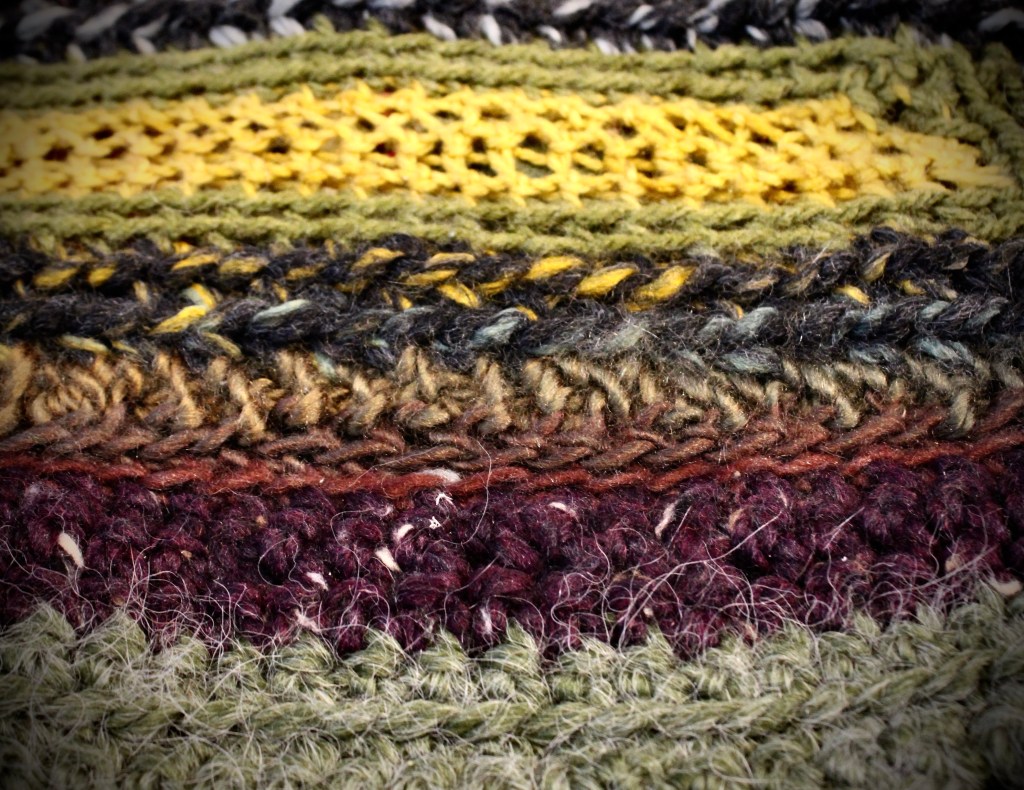
So, as an artist, I aspire to the nobility of the worm. I aspire to the vulture’s path. I serve all my communities by learning to eat… shit. And with that, spin wildly uneven yarn that we can use together to crochet new life, healthy connections, and webs of resilient communities.
And it’s no accident that I choose crochet, for my final metaphor, dear listener. Because knitting is the foundation of the entire digital age. And crochet? To this day, crochet cannot be done by a machine. It can only be done by hand. By human hands. Slowly, laboriously, with love.
And so, kind listener, I invite you to stumble along with me as I, the quintessential awkward duck, waddle along the riverbanks toward reconnection to the animate holiness of vultures and crochet.
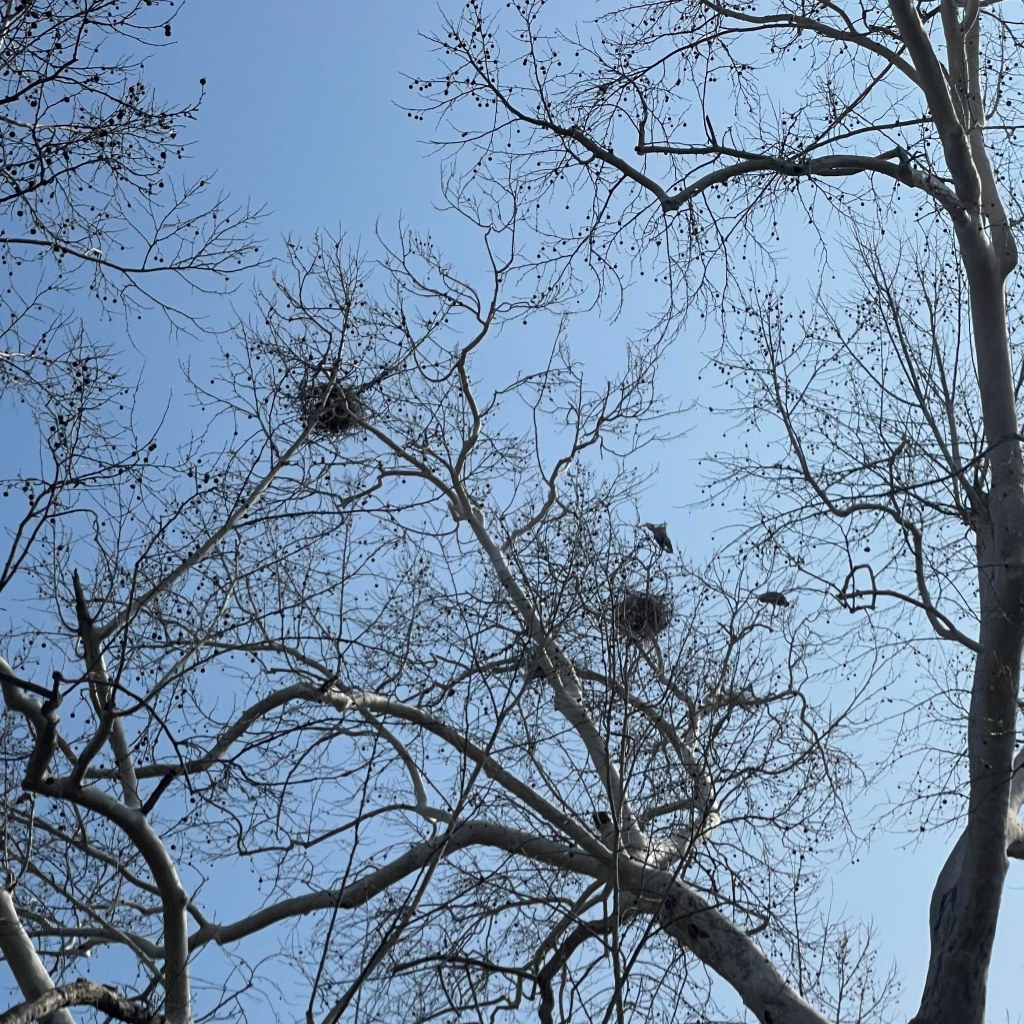
I didn’t have my good camera, so you’ll have to believe that those dark balls up in the tree are heron’s nests, not mistletoe.
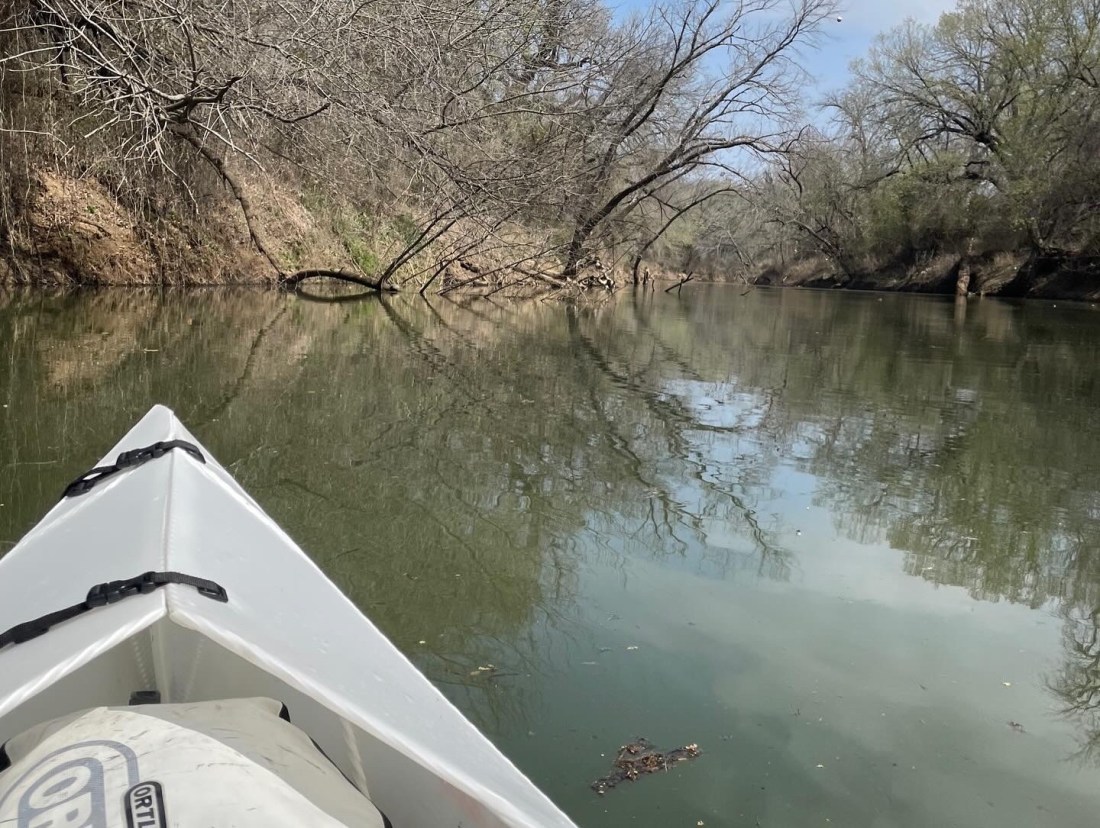
I went on a little adventure yesterday. Paddled upstream 4.64 miles in 3 hours. The current wasn’t bad in spots, but there’s a long stretch that seems unnaturally straight. It’s shallow and fast. Had to wade and drag the boat along behind. The whole business was much harder than I had anticipated (probably because I’m not very good at anticipating), but it was a wonderful experience.
The herons were not impressed.
I had paddled the kayak over to the bank to rest a moment, and two huge herons were suddenly upon me. They swooped and yelled, startling me. I hadn’t realized I was invading their nursery. When I paddled back from the bank, they retreated to their nests, watchful and irritable.
A little while later, having navigated maybe a dozen fallen trees (red-eared-slider conventions) and several areas where the limestone has eroded deeply in a long, sinuous channel, but where it is a wide, shallow shelf toward each bank, I came upon a place where erosion from a hilly area in the forest has created two little islands. As I passed the first, a raccoon (or beaver, I never really saw it) launched himself at my boat in fight-or-flight terror.
Of course, I screamed like a blonde in a slasher film.
And then I laughed and laughed and had to stop at the next little island to have lunch.
But it struck me that no matter how many plants and animals I had seen and recognized, there were countless others that had escaped my attention altogether. And I wonder about that.
Humans think we see a lot. We’re quite keen on how awesome we are. But we’re so rarely aware of what we don’t perceive. I hadn’t seen the herons, the raccoon or beaver, or several of the turtles who loudly protested my intrusion on their home. How many lives escaped the approach of my little kayak and never made a sound?
And what could I have learned from them if we could have made friends?


 Ducks of the World Tree